Justin Hume has spent this week telling anyone who’ll listen that South Africa’s premium phone market is in rude health. Samsung’s mobile chief for the region called the segment, foldables included, “incredibly resilient” even as the broader market wobbles, and with roughly 51% of local smartphone sales the company can back that confidence with shelf space. He even rolled out the velvet rope for Apple’s incoming foldable, quipping that imitation is the highest form of flattery. I reckon he’s half right. The resilience is real. The AI demand story doing the heavy lifting in the telling is shakier than Samsung admits, and the genuinely interesting news this week barely made the headlines.
The numbers back the swagger
Start with what we already tracked here. In the second quarter, Samsung’s South African shipments grew 15% year on year while the overall market rose around 17%, which we unpacked when the Q2 numbers landed. Read that carefully, because it tells you this isn’t a Samsung-only boom. It’s a market-wide migration toward pricier 5G devices.

Lift the bonnet and the picture gets more honest. I’ve argued before that our growth is being priced in as much as bought, and this week reinforced it. Memory and RAM costs are climbing globally because AI data centres are hoovering up supply, so a decent slice of the “premium growth” is simply the same phones costing more. Revenue up, absolutely. Demand surging entirely on its own merits, only partially.
Still, the premium ladder is doing its job. The Z Flip8 starts at R26,999, the Z Fold8 at R40,999, the Fold8 Ultra at R50,999, and the S26 FE arrived on 11 September to carry Galaxy AI down a price rung, with sign-in discounts of up to R3,000 running until 20 September. Our earlier look at Fold8 preorders and contracts showed how much of this rests on operators absorbing the commitment for buyers who can’t drop R40k in cash. That’s the actual engine of premium sales in this country. Financing deserves more credit than any AI demo.
Ask buyers what actually sold the phone
Here’s where the AI narrative starts creaking. I spent last weekend setting up a Z Fold8 for a family member, fresh out the box, and the experience was a muddle. Gemini is there, Perplexity is baked in, Samsung’s own assistant hovers behind both, and nothing in the setup flow explains what any of them are actually for. A tech commentator I follow landed on the same frustration days later:
So I went digging through aggregated buyer reviews on Samsung’s own SA store for the S26 range, and the pattern is clear. Battery life, display quality and cameras all score well above four stars. AI functionality sits around 3.7 out of 5, the weakest category in the feedback. South Africans are buying these phones for hardware and financing terms, enjoying the AI where it works and quietly shrugging where it doesn’t.
There’s friction the price should have solved by now too. The Z Fold8 ships without a telephoto lens at R40,999, a strange compromise for the creators Samsung courts, and apps on that inner screen still misbehave because resize support remains patchy. None of it dents 51% share. It does cap how much of the growth you can honestly pin on AI.
The quiet move is distribution, not demos
The most interesting Samsung news this week wasn’t a quote about Apple. It was the expanded Mitsumi partnership announced on 17 September, pushing Samsung’s B2B distribution into underserviced communities and independent resellers beyond the big operators and retail chains, in a local mobile market the company sizes at roughly R60bn. Whoever owns the pipes into those towns owns the upgrade cycle when today’s R27,000 Flip buyer trades up.
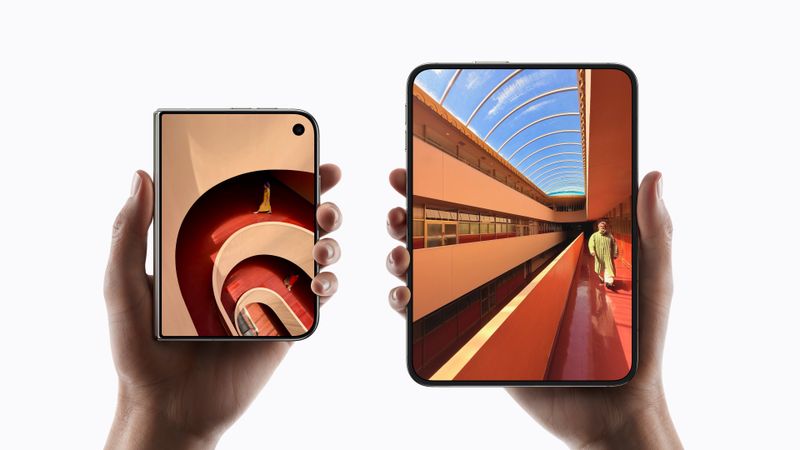
Which is also why Hume’s flattery line is sharper than it sounds. Samsung can welcome Apple’s foldable because the category growing matters more than winning every sale, at least for now. An iPhone foldable drags curious buyers into the form factor, and Samsung already has a device at every price rung from R26,999 to R51,999 plus early adopters who replace every couple of years. Eight years of foldable engineering and a complete range is a genuinely strong hand.
What comes next is agentic AI, the proactive kind that handles multi-step tasks in the background, pitched on on-device processing and an open ecosystem. Watch two things over the next year: whether memory costs keep pushing flagship prices up faster than salaries, and whether any Galaxy AI features quietly slide behind a subscription. That second one is where current goodwill evaporates.
My view is that Samsung has earned its bullishness the boring way, through financing partnerships, an unmatched price ladder and now distribution depth nobody else is bothering to build. AI is the garnish, not the meal, and pretending otherwise will look silly the day Apple ships a foldable with a telephoto lens. The 51% share is Samsung’s to lose. Stop selling the magic and start shipping the polish.