When Justin Hume, vice-president of Samsung Mobile SA, welcomed Apple into the foldable market this week with the line “imitation is the highest form of flattery”, it read like polished competitor diplomacy. It’s actually more literal than the PR suggests. Samsung doesn’t just tolerate the iPhone Duo arriving on our shores in October. It gets paid twice.
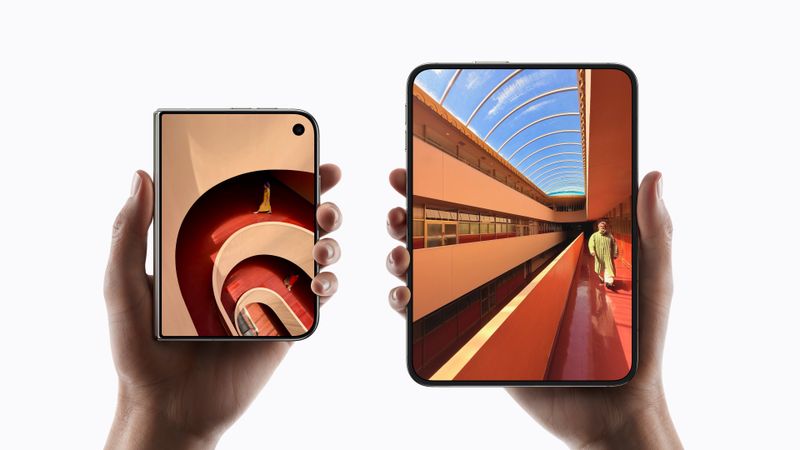
Apple unveiled the iPhone Duo, its passport-style foldable, on September 9 at $1,999 in the US, and South Africa made the first-wave cut, with iStore pre-orders opening October 16 and shipping starting October 23. That’s rare for us. We usually wait weeks behind the US and UK, so getting a flagship iPhone inside the global launch window is genuinely new. Local pricing estimates sit north of R50,000.
Hume’s answer was to point at Samsung’s eight years of foldable experience and a lineup running from the R26,999 Flip8 to a Fold8 Ultra that crosses R50,999. It sounded like grace. Underneath, it’s arithmetic.
The flattery is literal, and the invoice proves it
Here’s the part most of the reaction coverage skipped. Samsung Display supplies the foldable panels inside the iPhone Duo under a multi-year deal worth around $250 per unit. Run that through the exchange rate and there’s roughly R4,500 of Samsung glass sealed inside every R50,000 iPhone that clears customs at OR Tambo. Apple sells a phone built to compete with the Z Fold8, and Samsung books revenue on the component inside it.
I’ve watched the response unfold on X since the announcement, and the sharpest take I came across cut straight to it. Samsung’s launch-day trolling of Apple was tacky, but the position underneath is untouchable. Either South Africans buy foldables and Samsung’s estimated 51% share of the local smartphone market absorbs the competition, or they buy the iPhone and Samsung’s display division eats anyway.

That’s why the warmth is genuine. Samsung launched the Galaxy Z Fold8 range here in mid-August, so every week Apple spends teaching South Africans that folding phones are normal is a week Samsung’s portfolio sits fully stocked as the answer. We already ran the Fold8 Ultra versus the iPhone comparison if you want the spec fight in detail.
The R50,000 question South Africans keep asking
Price dominates every local thread I’ve tracked. In the SAtechnews discussions since the Duo’s pricing surfaced, the same maths keeps repeating. Why spend R50,000 on one folding phone when two excellent regular flagships cost less combined, or when Samsung trade-in deals will inevitably gut the Fold8’s effective price? Nobody in those threads doubts the Duo is impressive. They doubt who it’s for.
The answer is a very thin slice, and it sits against a strange backdrop. In 2025 government granted tax relief on entry-level phones under R2,500 to widen adoption, and it worked. Two years on, the premium conversation is about devices costing twenty times that threshold. Both realities are true at once, and both decide who gets to participate in this country’s smartphone story.
Then there’s repair risk, which local forums keep raising and mainstream coverage keeps burying. Foldables carry a history of crease and hinge complaints across every brand, and premium panel repairs have been quoted above $1,000 internationally. In a weak rand economy with almost no carrier subsidy for ultra-premium devices, cracking a R50,000 screen isn’t an inconvenience. It’s a second purchase. And because Samsung supplies those panels, your Duo repair bill and Samsung’s component pricing run through the same supply chain.
What to watch before October 23
The timing gap matters more than it looks. Regular iPhones ship mid-September, but the Duo only lands October 23, handing Samsung a five-week head start with exactly the early adopters Apple wants. The Fold8 has been on shelves since mid-August, and I expect aggressive trade-in bundles from Samsung and the carriers in the run-up to iStore pre-orders, precisely to lock buyers into contracts first. We explained how Fold8 pre-orders and contract commitments work locally, and that structure is about to become the battleground.
Hume’s quieter point deserves credit too. Foldable buyers, he argues, upgrade faster and stay more loyal than standard flagship customers, which matches what we’ve seen in Samsung’s premium sales run locally. If that holds, Samsung’s existing base absorbs Apple’s entry far better than the global share-loss panic assumes. The bigger prize might be financing. If Apple’s arrival pressures carriers into proper foldable instalment plans, the biggest winner is the R26,999 Flip8, not the R50,000 anything.
My honest take? Welcome the competition, just don’t miss the actual story. This isn’t Samsung versus Apple. It’s two companies agreeing foldables are the future while the median South African buyer is still counting rands under R2,500. And there’s something quietly delicious about Apple’s most ambitious iPhone ever carrying Samsung hardware at its heart. Flattery, it turns out, invoices beautifully.